How to Sponsor Work Visas in Türkiye as a Foreign Business

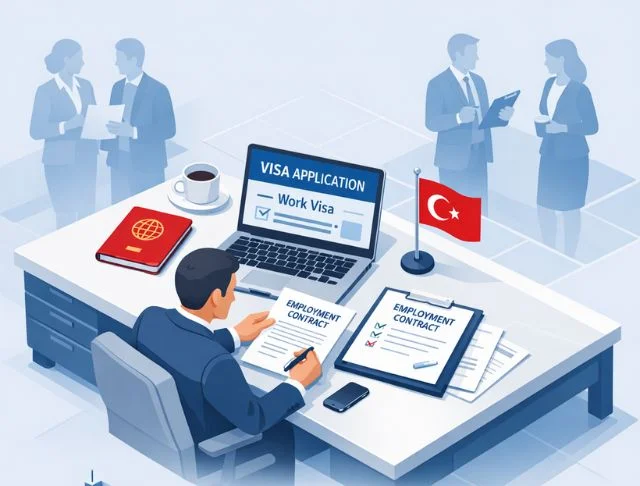
A work visa is mandatory for foreign employees as a work permit in Türkiye.

Foreign companies usually hire local employees, but sometimes they face additional hiring challenges when the best candidate for the role is non-Turkish.

So, as an overseas company, understanding local rules and sponsoring a work visa isn’t straightforward. This is why most companies outsource it. But in this post, we’ll cover how you can sponsor work visas in Türkiye yourself.

Picture of Özlem Çanakçı
Özlem Çanakçı

Author

Picture of Alp Atasoy
Alp Atasoy

Co-author

How to Sponsor Work Visas in Turkiye as a Foreign Business

How to Sponsor Work Visas in Türkiye as a Foreign Business

A work visa is mandatory for foreign employees as a work permit in Türkiye.

Foreign companies usually hire local employees, but sometimes they face additional hiring challenges when the best candidate for the role is non-Turkish.

So, as an overseas company, understanding local rules and sponsoring a work visa isn’t straightforward. This is why most companies outsource it. But in this post, we’ll cover how you can sponsor work visas in Türkiye yourself.

Picture of Özlem Çanakçı
Özlem Çanakçı

Author

Picture of Alp Atasoy
Alp Atasoy

Co-author

Table of Contents

Get in Touch with Us

Alp Atasoy

Alp Atasoy

Sales and Business Development Consultant

united states flag turkey flag france flag

Understanding Work Visas in Türkiye

Understanding Work Visas in Turkiye

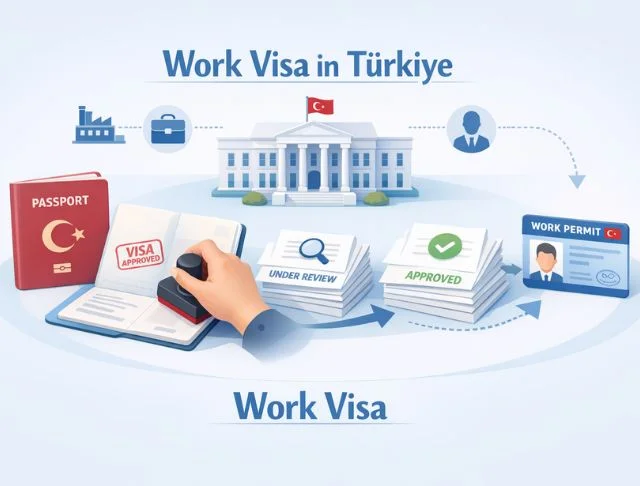
Getting a work visa in Türkiye is done through a two-step system. Foreign employees enter the country with a work visa and receive the actual legal authorization to work through a work permit.

The Ministry of Labor and Social Security issues the work permit. It is mandatory for all foreign hires and is also employer-specific. This means the employee can work only for the sponsoring company.

The good thing is that once a work permit is approved, it also serves as a residence permit. Therefore, you don’t need to apply for a separate residence permit for your employees.

Requirements for Foreign Companies to Sponsor Work Visas in Türkiye

There are strict legal and financial criteria for foreign companies to hire international employees in Türkiye. The application is always initiated by the employer, not the employee.

Company Requirements

To sponsor a work visa, the employer must:

  • Be a legally registered entity in Türkiye
  • Meet minimum capital requirements (often around 500,000 TRY or equivalent benchmarks)
  • Comply with the 5:1 rule (5 Turkish employees per foreign hire, with exceptions)
  • Be compliant with tax and social security obligations

Please note that these rules may change in accordance with applicable laws at any time. For the latest updates, please contact us.

Employee Requirements

The foreign employee must provide:

  • A valid passport
  • A signed employment contract
  • Proof of qualifications (degree, certifications)
  • Biometric photos and application forms
  • Role-Based Restrictions

Certain jobs in Türkiye are restricted to Turkish citizens, especially in:

  • Legal professions
  • Public sector roles
  • Security-related jobs

In addition to all this, salaries must meet minimum thresholds based on role level.

Processing Time for Work Visas in Türkiye

The standard processing time for work permit approval is 30 to 60 days. An additional 5 to 15 days are required for visa issuance.

Overall, the full process typically takes 4 to 8 weeks. This duration depends on document completeness, industry, role, and government workload.

Costs of Getting a Work Visa in Türkiye

The total cost of getting a work visa includes the following:

  • Work permit fee
  • Work permit card fee
  • Consulate visa fee
  • Translation and notarization costs

The average total cost ranges between $250 and $800 per employee. The cost varies based on permit type and services used. Note that additional costs may arise if companies use legal consultants or employers of record.

10 Work Visa Rules for Employers

Below are the ten most common and must-follow rules when obtaining a work visa for your foreign employees:

  • Obtain a valid work permit before employment  
  • Ensure the application is submitted by the employer  
  • Comply with the 5:1 Turkish employee quota rule  
  • Meet minimum capital and financial requirements  
  • Pay salaries above legal minimum thresholds
  • Submit the work permit application within the legal timeline (10-day rule)
  • Provide complete and accurate documentation
  • Register the employee with social security (SGK)
  • Maintain ongoing tax and payroll compliance
  • Ensure the employee works only for the sponsoring employe

Step-by-Step Process to Sponsor a Work Visa in Türkiye

Step by Step Process to Sponsor a Work Visa in Turkiye

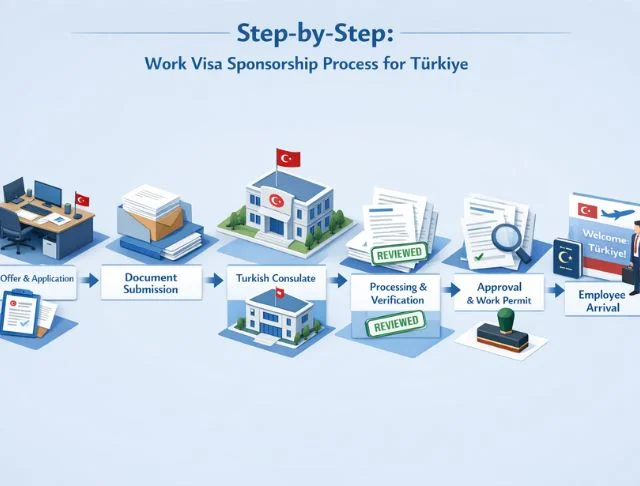
You have gained all the important information about sponsoring a work visa in Türkiye. This is the core section to guide you on how you can sponsor it in a few easy steps:

Step 1: Define the Role and Prepare an Employment Contract

Before starting any visa process, the employer must clearly define the job role:

  • Decide job title, responsibilities, and salary
  • Ensure the role complies with Turkish labor regulations
  • Prepare a formal employment contract

Employment Contract Requirements and Legal Compliance (Türkiye)

The employment contract must include the following key elements:

  • Salary (must meet the minimum thresholds for foreign employees)
  • Working hours
  • Job description
  • Duration of employment
  • Employee’s place of work

Employee’s Place of Work:
This refers to the workplace address declared by the employer to the Ministry of Labour and Social Security during the work permit application. The foreign employee is legally permitted to work only at this specified workplace address and cannot be employed or assigned to any other location. For example, if the company is registered and approved for Istanbul, the employer cannot legally hire or assign a foreign employee to work outside Istanbul or any other declared city/worksite.

Duration of the Contract:
This employment contract is concluded for a fixed term of 2 years (or as applicable in years/months), starting from the date specified in the work permit issued by the Ministry of Labour and Social Security. The contract automatically terminates upon its expiry date without the need for any prior notice.

If the employee is to continue working in the same workplace after the contract period ends, it is mandatory to renew the employment contract and submit an application for a work permit extension to the Ministry of Labour and Social Security to obtain a renewed work permit. Indefinite-term contracts are not applicable in this context.

Step 2: Initiate Work Visa Application via Turkish Consulate (Employee Side)

There are two ways to apply for a work visa as an employee. They can either apply at the Turkish embassy or consulate in their home country. Additionally, the employee must have a residence visa with a minimum validity of six months.

  • Submit visa application form
  • Provide passport and supporting documents
  • Submit employment contract provided by employer
  • Attend interview if required
  • Receive a visa reference number / application number

This step is most important for foreign employees before they enter Türkiye.

Step 3: Submit Work Permit Application (Employer Responsibility)

The employer must apply in Türkiye, while the employee applies at the consulate.

  • Employer submits application to the Turkish Ministry of Labour and Social Security
  • Application is usually done online through the official system
  • Must be completed within 10 working days after visa application

Both applications (employee + employer) must match and be linked.

Step 4: Prepare and Submit Supporting Documents

Below is the list of documents that an employee and employer are required to obtain a work visa and work permit:

Required Documents for Employers

  • Company tax registration certificate
  • Trade registry gazette
  • Balance sheet and profit/loss statement
  • Proof of minimum local employee quota (usually 5 Turkish employees per foreign worker)
  • Signed employment contract
  • Company authorization letter

Required Documents for Employees

  • Valid passport
  • Passport-size photos
  • Signed employment contract
  • Academic qualifications (with notarized translations)
  • CV / resume
  • Work visa application form
  • Criminal record certificate (in some cases)

Step 5: Await Work Permit Approval

After submission, the ministry reviews the application. This process can take 2 to 6 weeks. During this time, the authorities evaluate:

  • Company eligibility
  • Job position validity
  • Salary compliance
  • Foreign worker quota rules

If it get approved then:

  • Work permit is issued
  • It also serves as a residence permit

Step 6: Arrange Employee Entry and Post-Arrival Registration in Türkiye

Once the work permit is approved:

  • Employee can legally enter Türkiye (if not already inside)
  • Register address with local authorities in the employer’s city.
  • Complete biometric registration (if required)
  • Employer completes onboarding process
  • Employee can start working legally

If the application is rejected, under Article 23/9 of Law No. 6735, the employer or employer’s representative is responsible for covering the foreign employee’s accommodation costs, the return travel expenses to their home country (including dependents, if any), and any necessary medical expenses.

Work Visa vs Direct Hiring vs EOR vs Freelancers

Work Visa vs Direct Hiring vs EOR vs Freelancers

Factor

Work Visa (Foreign Hire)

Direct Hiring (Local Entity)

EOR (Employer of Record)

Freelancers

Legal Employer

Your company

Your company (local entity)

EOR provider

Self-employed individual

Local Entity Required

Yes

Yes

No

No

Setup Time

Medium (4–8 weeks)

Slow (6–12+ weeks)

Fast (5–10 days)

Very fast

Compliance Responsibility

Employer

Employer

EOR handles compliance

Limited (risk of misclassification)

Work Permit Handling

Required

Not required for locals

EOR manages permits

Not applicable

Cost Structure

Moderate (visa + legal)

High (setup + operations)

Monthly fee per employee

Low upfront

Payroll & Taxes

Employer-managed

Employer-managed

Fully managed by EOR

Managed by freelancer

Flexibility

Low

Low

High

Very high

Risk Level

Medium (compliance errors)

High (legal + tax risks)

Low (outsourced compliance)

High (misclassification risk)

Best For

Hiring foreign talent

Long-term expansion

Fast, compliant market entry

Short-term or project work

Using FMC Group as Your Employer of Record (EOR) in Türkiye

Using FMC Group as Your Employer of Record EOR in Turkiye

When hiring international employees, a foreign employer must go through:

  • Company formation (includes multiple steps and is critical)
  • Finding employees
  • Screening and interviews
  • Onboarding
  • Managing payroll
  • Handling taxes
  • Submitting monthly premiums (employee insurance)
  • Keeping records of all transactions
  • Maintaining compliance with local labor laws
  • Getting a work visa
  • Obtaining a work permit

This process can take weeks to months, and you may incur extra costs and face legal penalties.

The best approach is to partner with FMC Group and let them handle all of this. We offer employer of record services (where you don’t need a legal entity), recruitment services, and finance services (where we handle payroll and monthly submissions). You can schedule a consultation call free of cost and start hiring immediately. 

Get In Touch With Alp

We are looking forward to hearing from you