Foreign employers classify workers as independent contractors, often just by signing an agreement and considering it enough for compliance. In Germany, this assumption can become an expensive mistake.
German authorities apply a substance-over-form approach. In simple terms, they examine the actual working relationship rather than the contract’s title when determining employment status.
If authorities reclassify a worker as an employee, employers may face social security back payments, tax liabilities, employment law claims, and regulatory investigations. This guide explains the key worker misclassification risks and how to reduce them.

Author
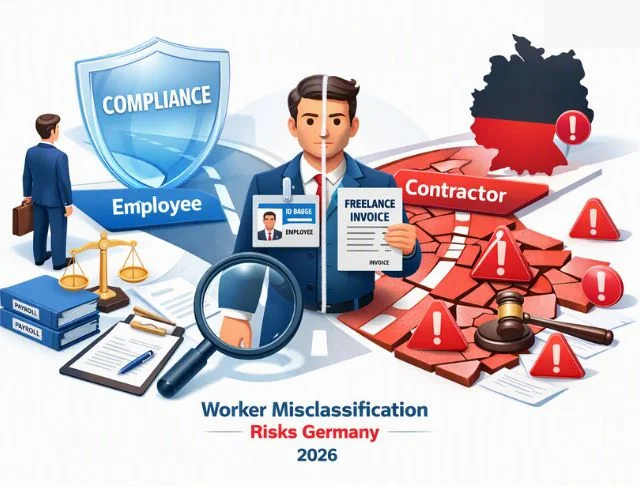
Foreign employers classify workers as independent contractors, often just by signing an agreement and considering it enough for compliance. In Germany, this assumption can become an expensive mistake.
German authorities apply a substance-over-form approach. In simple terms, they examine the actual working relationship rather than the contract’s title when determining employment status.
If authorities reclassify a worker as an employee, employers may face social security back payments, tax liabilities, employment law claims, and regulatory investigations. This guide explains the key worker misclassification risks and how to reduce them.
Author
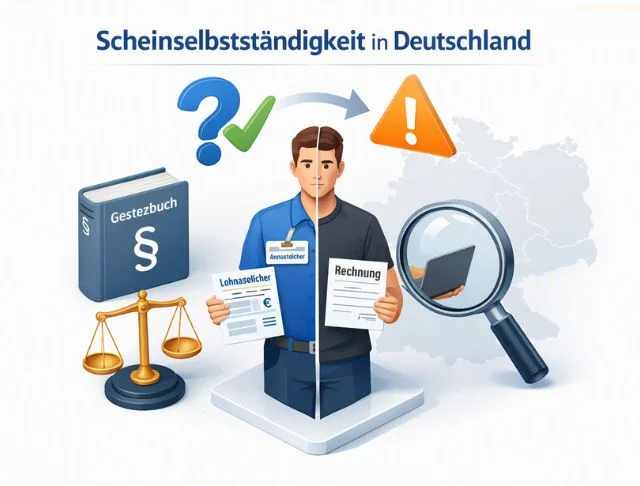
Worker misclassification, known in Germany as Scheinselbstständigkeit (“false self-employment”), occurs when a person is treated as an independent contractor even though, in practice, they work like an employee.
Under Section 7 of the German Social Code IV (SGB IV), employment status is determined by the actual working relationship, not simply by what the contract says.
Germany oversees worker misclassification to protect individuals who are economically dependent on a single client. These workers function as employees without receiving the legal protections and social security benefits available to employees. These rules help ensure employers meet their obligations related to payroll, taxes, and social security.
Official Insight (DRV): “If day-to-day working practice differs from the contract, the actual circumstances are decisive.”
Reddit Reality: “Calling it freelance doesn’t make it legal. Scheinselbstständigkeit means calling someone a “freelancer” while they actually work like an employee. The contract name doesn’t matter, reality does.”

Many foreign employers engage contractors in Germany because it is faster and simpler. This is especially common when hiring remote workers, paying through global payroll platforms, or using independent contractor agreements for long-term projects.
Misclassification risks increase when contractors work exclusively for one company, follow fixed working hours, use company systems, and report to managers. Simply stated, they perform the same duties as employees. A long-term, exclusive relationship is one of several factors that may indicate Scheinselbstständigkeit (false self-employment).
Reddit Reality: “We both work full time remotely in the same company that is located in USA and we’re not planning to change that in the near future. But it looks like because of that we can be considered as Scheinselbstständigkeit (False self-employed).”
This scenario shows a common cross-border hiring model, but it can raise worker misclassification concerns in Germany. In the same discussion, users noted that working long-term for only one company is a major indicator.

Germany does not rely on a single test to determine whether someone is an employee or an independent contractor. Instead, the Deutsche Rentenversicherung (DRV), courts, and other authorities examine the entire working relationship under Section 7(1) SGB IV.
A written contractor agreement is relevant, but it is not decisive. If the day-to-day working relationship differs from the contract, the actual circumstances take precedence. This means a well-drafted freelance agreement cannot prevent worker misclassification if the worker is working like an employee while being classified as a contractor on paper.
Key factors that German authorities may use to determine employment status include:
Factor | May Indicate Employment | May Indicate Self-Employment |
Instructions | Client controls how work is performed | Contractor decides how to deliver the work |
Supervision | Ongoing oversight and approval | Works independently without close supervision |
Integration | Integrated into the client’s organization, teams, and workflows | Operates an independent business |
Reporting | Regular reporting obligations to managers | Reports only on agreed deliverables |
Substitute rights | Must perform the work personally | Can engage qualified substitutes where appropriate |
Entrepreneurial freedom | Little commercial risk or pricing freedom | Bears business risk and controls pricing, clients, and investments |
German courts apply the same “totality of the circumstances” approach. They assess all relevant factors together instead of relying on a checklist. No single factor can decide the outcome. Even when the DRV has made a status determination, courts can reach different conclusions based on the evidence.
For example, in Social Court Düsseldorf (Sozialgericht Düsseldorf), Case S 45 R 1190/14, the court overturned the DRV’s finding of dependent employment after evaluating the complete factual circumstances. The judgment illustrates that employment status depends on the overall reality of the relationship. It includes entrepreneurial risk, independence, and the practical performance of the work.
German authorities often examine situations where an employee leaves a company and later returns as an independent contractor while continuing to perform substantially the same work.
Although this arrangement is not automatically unlawful, it may raise questions about whether the employment relationship genuinely ended. If the contractor continues working under similar supervision, follows the same working hours, or remains integrated into the organization, authorities may conclude that the individual is still an employee despite the new contract.
Foreign employers should carefully review these arrangements before engaging former employees as contractors.
German authorities primarily assess two legal concepts when determining employment status: direction (Weisungsgebundenheit) and integration (Eingliederung). These two indicators carry significant weight during a status assessment.
Direction means the client controls how, when, or where the contractor performs the work. The more instructions the worker must follow, the more the relationship resembles employment rather than genuine self-employment.
Integration refers to how closely the contractor becomes part of the client’s organization. Working with internal teams, using company systems, attending regular meetings, and following internal procedures may indicate that the individual functions as an employee instead of operating an independent business.
While neither factor is decisive on its own, the combination of significant direction and deep integration often increases the likelihood that German authorities will classify the relationship as employment.

As mentioned earlier, no single factor automatically creates Scheinselbstständigkeit. However, the following indicators frequently appear in German status assessments. The more red flags that exist together, the greater the risk.
Contractors who must follow fixed daily schedules or company shift patterns resemble employees because they lack the flexibility expected of independent contractors.
Working almost exclusively for one client over a long period can indicate economic dependence, especially when the contractor has little opportunity to build other business relationships.
Regularly using the client’s laptop, software, office space, or other essential tools shows integration into the company’s operations rather than running an independent business.
If contractors submit routine reports, attend team meetings, or obtain regular approval from managers, it is a red flag.
Genuine contractors normally decide when they work. Requiring approval before taking leave is an indicator of misclassification.
Close supervision over how work is performed, rather than simply evaluating results, indicates an employment relationship.
If the contractor must personally perform the work and cannot appoint a qualified substitute, this weakens the argument that they operate an independent business.
Receiving a fixed monthly payment regardless of workload resembles employment. Contractors should invoice clients for completed projects or agreed deliverables instead.
Using a company email address, appearing on internal directories, or representing the business externally may indicate integration into the employer’s organization.
Contractors with guaranteed income, no financial investment, and no possibility of profit or loss appear more like employees.

A worker misclassification finding can trigger liabilities under social security, tax, employment, and regulatory law simultaneously.
One of the largest financial risks is the payment of retroactive social security contributions. If the DRV concludes that a contractor was actually an employee, the employer may have to pay retroactive social security contributions – typically for up to four years, or up to 30 years in cases of intentional misclassification – plus monthly late-payment surcharges of 1% of the outstanding amount.
A reclassification can also create payroll tax liabilities. German tax authorities may determine that wage tax should have been withheld, and the employer may have to pay it for all previous months, depending on their decision.
If a contractor is recognized as an employee, they may be entitled to statutory employment rights. Depending on the facts, this can include claims relating to paid annual leave, continued remuneration during illness, notice periods, overtime, and protection under German employment law.
In addition to all this, authorities may impose interest on overdue social security contributions. Tax liabilities may also accrue interest.
Beyond financial exposure, misclassification can trigger criminal liability. Under Section 266a of the German Criminal Code (StGB), responsible individuals within the company can face fines or imprisonment of up to five years for failing to remit employee social security contributions.
Worker misclassification is not only a labor law issue. It may attract scrutiny from other German authorities. Investigations may involve:

If you believe a contractor may have been incorrectly classified, taking action early is usually less costly than waiting for a government audit or dispute.
Assess whether contractors work independently in practice rather than simply relying on the written contract. Consider factors such as supervision, working hours, integration into the business, and economic independence.
Where uncertainty exists, employers can request a Statusfeststellungsverfahren through the Deutsche Rentenversicherung (DRV). A formal determination provides legal certainty regarding the worker’s employment status based on the actual facts of the engagement.
If the engagement resembles employment, employers should consider restructuring the working relationship or hiring the individual as an employee. Foreign employers without a German legal entity often use an Employer of Record (EOR) to employ workers compliantly while avoiding local payroll and employment administration.

Here are two effective and practical ways that FMC Group recommends for foreign employers to significantly reduce the misclassification risk:
As a foreign employer, you can obtain a formal status determination before a dispute or audit arises. Germany provides a legal mechanism called the Statusfeststellungsverfahren. The Clearing Office (Clearingstelle) of the Deutsche Rentenversicherung Bund (DRV) administers this procedure. Through it, the parties can obtain a legally binding determination on whether a working relationship is one of dependent employment or genuine self-employment under Section 7a SGB IV.
Sentence to copy/paste (replacement): “Since April 2022, German law has allowed employers to request a prospective (forecast) decision before the engagement starts. This provision is currently a temporary, probationary measure scheduled to remain in effect through June 30, 2027, pending a government review of its effectiveness.
Limitations Employers Should Understand: Although it is valuable, it is not a guarantee against future compliance issues. Even if you have a Statusfeststellungsverfahren decision, if you later start treating the contractor like an employee, the authorities may audit the relationship and change the status.
The safest approach is to hire employees using an Employer of Record (EOR) service. If you want to cut costs, you can hire a contractor, but you must be careful. However, if you want to avoid legal entity formation, payroll, taxes, social security contributions, and HR administration, an EOR is the best option. You pay a fee per employee per month and hire hassle-free. This is how well-structured companies hire internationally.
You are currently viewing a placeholder content from Calendly. To access the actual content, click the button below. Please note that doing so will share data with third-party providers.
More InformationYou are currently viewing a placeholder content from Calendly. To access the actual content, click the button below. Please note that doing so will share data with third-party providers.
More InformationYou need to load content from reCAPTCHA to submit the form. Please note that doing so will share data with third-party providers.
More InformationYou are currently viewing a placeholder content from Turnstile. To access the actual content, click the button below. Please note that doing so will share data with third-party providers.
More InformationYou are currently viewing a placeholder content from Vimeo. To access the actual content, click the button below. Please note that doing so will share data with third-party providers.
More InformationYou need to load content from reCAPTCHA to submit the form. Please note that doing so will share data with third-party providers.
More InformationYou are currently viewing a placeholder content from Elfsight. To access the actual content, click the button below. Please note that doing so will share data with third-party providers.
More InformationYou are currently viewing a placeholder content from reCAPTCHA. To access the actual content, click the button below. Please note that doing so will share data with third-party providers.
More Information