In this post, I’m going to show you how you can plan employee benefits as a foreign employer in Türkiye.
In fact, this is the exact WORKING process we have been using at FMC Group to hire employees, provide benefits, and act as an employer of record (EOR) for 15 years.
This blog covers all the benefits the Turkish government has made mandatory, market-standard benefits, competitive benefits, and more.
Without further delay, let’s start planning…
Author
Co-author
In this post, I’m going to show you how you can plan employee benefits as a foreign employer in Türkiye.
In fact, this is the exact WORKING process we have been using at FMC Group to hire employees, provide benefits, and act as an employer of record (EOR) for 15 years.
This blog covers all the benefits the Turkish government has made mandatory, market-standard benefits, competitive benefits, and more.
Without further delay, let’s start planning…
Author
Co-author
Get in Touch with Us
Alp Atasoy
Sales and Business Development Consultant
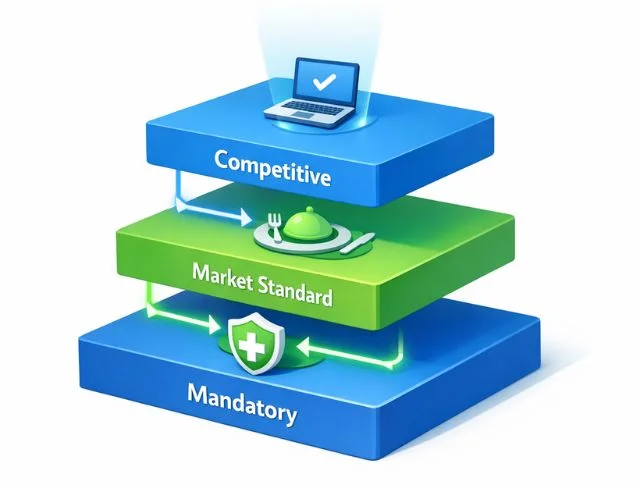
Although you can provide statutory benefits, comply with local laws, and hire employees, if you miss other benefits, you may have difficulty with smooth hiring. Here is what this means:
This category contains all the benefits that an employer, whether foreign or local, has to provide after hiring in Türkiye. These benefits are also mandatory if you hire a foreigner. However, there are some additional requirements, such as a work permit. These essential benefits are:
These benefits are non-negotiable and form the legal baseline for employment in Türkiye.
This category includes benefits that the Turkish government does not require, but employees expect them from companies. Missing these benefits can lead to losing good talent and credibility among employees. These benefits are:
These are benefits that neither the Turkish government requires nor employees demand. However, adding them to your hiring package can help you attract employees faster and improve retention.
In simple terms, these are extra benefits that help attract top-tier candidates. Such benefits could include:
These benefits differentiate foreign employers from local competitors and improve talent retention.
Below are three scenarios that explain how the three layers of employee benefits differ:
You hire an employee.
You offer a salary and legal benefits.
You comply with laws and avoid penalties.
But you will have a hard time hiring.
Your competitor hires an employee.
Your competitor offers a salary and legal benefits.
Your competitor wins by offering meals and private insurance.
Despite complying with local laws, you lose the talent.
An EOR hires an employee in Türkiye.
The EOR offers a salary and legal benefits on your behalf.
The EOR outperforms your competitors by offering overseas currency salaries, meals, insurance, remote work, and extra leave.
The EOR helps you hire top-tier Turkish employees with full compliance.
Below are all the benefits that an employer has to provide as per legal requirements. Let’s get an overview of each of them one by one:
There is an institution in Türkiye that requires every employee to submit a monthly premium. However, these monthly contributions are collected and submitted by employers. This is a state insurance system that covers:
It significantly increases the cost of employment in Türkiye, typically around 22–25% of salary.
The Turkish government has a structured system for providing paid annual leave to employees. These leave entitlements increase based on years of experience:
Note that these leave entitlements cannot be reduced, and employers cannot deduct salary. The only option is to increase benefits in line with legal requirements.
For all officially recognized public holidays in Türkiye, employers must provide paid leave, regardless of whether the employee is a foreigner or not. If a public holiday falls during an employee’s leave period, the employer cannot deduct salary for those days.
It is also important to note that if an employee works on a public holiday, the employer must pay additional compensation beyond the standard rate.
The government provides protections for employees in situations such as maternity and paternity. Employers must provide 16 weeks of maternity leave and 5 days of paternity leave.
As part of employment protections, sick leave is provided when an employee submits a valid medical report. The Social Security system (SGK) partially covers payments during this period, while employers are responsible for maintaining proper documentation.
Working hours are regulated for employees. Overtime rates and limits are also fixed and cannot be adjusted by either party.
Employees can work a maximum of 45 hours per week. For overtime, employers must pay 1.5 times the regular rate.
Enrollment in private pension schemes is mandatory. This is an automatic enrollment system that requires a 3% salary contribution from the employee. A private pension is a long-term savings system that employers also administer.
Below are the employee benefits that are currently expected by employees after joining. Let’s take a look at how to include them in employee benefits planning in Türkiye:
Private Health Insurance: This is additional coverage beyond SGK monthly premiums. Employees expect it due to faster treatment and access to better hospitals. This type of insurance is common in international companies.
Meal Allowance (Yemek Kartı): Employers provide daily meals through card-based systems. This is a widely used practice in Türkiye and has become standard for most jobs. Providing meals has a high perceived value and is a tax-efficient system.
Transportation Allowance: If you have a representative office, liaison office, or require employees to work onsite, providing transportation support is important. While not legally required, it addresses employee needs. Transportation adds significant costs for employees, making this benefit attractive. You can provide cash support, shuttle services, or public transport assistance.
Bonuses (13th salary / performance): This is additional pay beyond the base salary, often structured as a 13th salary. It helps drive motivation and improves employee retention.
The core idea behind competitive benefits is that they are not required by law and not expected by all employees. However, they differentiate your company and help attract top talent:
High-impact benefits make your offer more attractive and improve retention. These benefits include:
Executive-level roles are attracted to more advanced benefits than those commonly offered. These benefits help retain senior talent and signal prestige and long-term commitment. Here are some examples of such benefits:
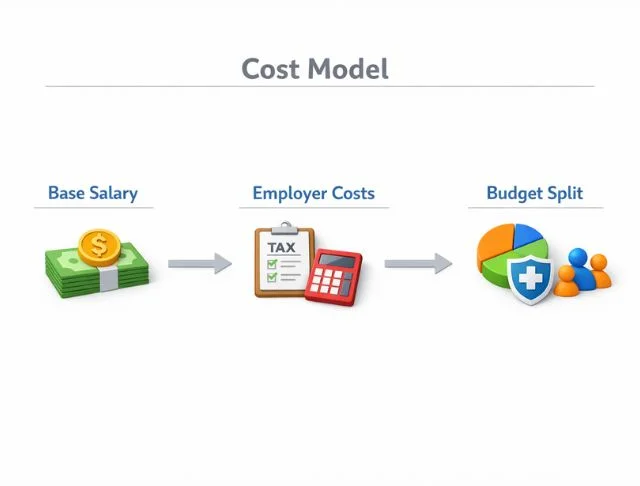
Until now, we have learned what types of benefits you need to include when planning employee benefits and what they entail. Now let’s plan the cost of providing these benefits:
This is the gross salary agreed upon with employees. This salary can be in TRY, EUR, or USD. Remember that taxes, SGK contributions, and other elements are calculated based on the gross salary, not the net salary. For example, the base salary is €2,000/month.
Next, calculate mandatory contributions and obligations, including:
Total cost = Base salary + employer costs
Example: €2,000 + €500 = €2,500/month
Below is a clear breakdown of the total budget to give you an idea of the cost of hiring each employee:
Component | % of Total Cost |
Base Salary | 70–75% |
Social Security / Mandatory Costs | 20–25% |
Additional Benefits | 5–15% |
Now, let’s discuss a crucial step of hiring that is a bottleneck for every foreign employer. The choice directly affects compliance, cost, speed, and employee retention. This bottleneck is how to hire employees in Türkiye, and the answer is that you have three options:
You can hire employees in Türkiye by registering a limited liability company (LLC), a joint stock company (JSC), or by establishing a representative or liaison office.
You’ll have full control over your employees, but this option is costly, slow, and time-consuming.
Employees work as independent contractors. You pay them via invoices rather than payroll. This option is fast but risky, and legal misclassification is common.
An Employer of Record is a third-party company that employs staff locally on your behalf. The best part is that you don’t need to register a company, handle payroll, recruit employees, or manage benefits.
EOR = fast, compliant, scalable, and optimal for foreign employers.
If you decide to hire yourself, create a mini plan to handle employee benefits and integrate it into a larger plan that includes company formation, budget planning, finance management, and more.
If you want to hire through an EOR, schedule a free 30-minute consultation call with FMC Group. We’ll guide you at every step, as we offer a complete set of solutions for foreign employers that you can explore here.
You are currently viewing a placeholder content from Calendly. To access the actual content, click the button below. Please note that doing so will share data with third-party providers.
More InformationYou are currently viewing a placeholder content from Calendly. To access the actual content, click the button below. Please note that doing so will share data with third-party providers.
More InformationYou need to load content from reCAPTCHA to submit the form. Please note that doing so will share data with third-party providers.
More InformationYou are currently viewing a placeholder content from Turnstile. To access the actual content, click the button below. Please note that doing so will share data with third-party providers.
More InformationYou are currently viewing a placeholder content from Vimeo. To access the actual content, click the button below. Please note that doing so will share data with third-party providers.
More InformationYou need to load content from reCAPTCHA to submit the form. Please note that doing so will share data with third-party providers.
More Information