Türkiye Employee Insurance Guide for Foreign Firms

The Turkish government requires employers to comply with strict labor laws, one of which mandates providing insurance to employees.

Employee insurance in Türkiye is somewhat complex for foreign employers due to regulatory changes. It also adds cost to the hiring process and carries the risk of non-compliance. Meeting deadlines while handling other duties, such as taxes, makes employers even more stressed.

In this post, we specifically discuss providing insurance to employees, including its types, total cost, and the ways companies use to outsource it.

Picture of Özlem Çanakçı
Özlem Çanakçı

Author

Picture of Alp Atasoy
Alp Atasoy

Co-author

Turkiye Employee Insurance Guide for Foreign Firms

Türkiye Employee Insurance Guide for Foreign Firms

The Turkish government requires employers to comply with strict labor laws, one of which mandates providing insurance to employees.

Employee insurance in Türkiye is somewhat complex for foreign employers due to regulatory changes. It also adds cost to the hiring process and carries the risk of non-compliance. Meeting deadlines while handling other duties, such as taxes, makes employers even more stressed.

In this post, we specifically discuss providing insurance to employees, including its types, total cost, and the ways companies use to outsource it.

Picture of Özlem Çanakçı
Özlem Çanakçı

Author

Picture of Alp Atasoy
Alp Atasoy

Co-author

Table of Contents

Get in Touch with Us

Alp Atasoy

Alp Atasoy

Sales and Business Development Consultant

united states flag turkey flag france flag

Understanding Employee Insurance in Türkiye

Understanding Employee Insurance in Turkiye

This section explains the working process of the Türkiye insurance system for employees. It is intended to help understand the structure of Türkiye’s mandatory social security system, including its legal framework and compliance complexities.

What Is Employee Insurance in Türkiye?

Employee insurance in Türkiye refers to the mandatory social security system managed by SGK (Sosyal Güvenlik Kurumu).

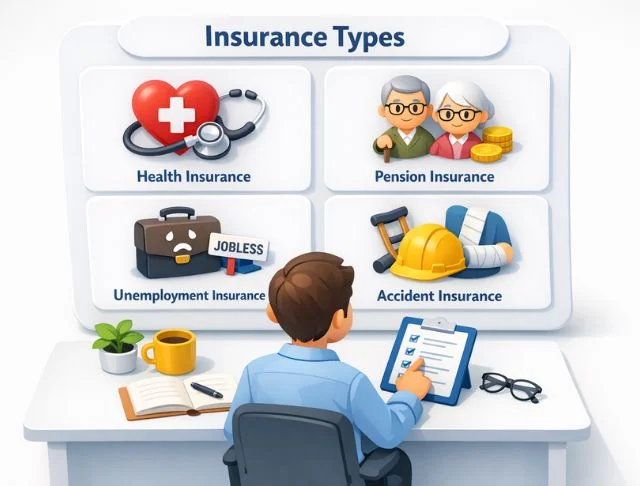
This insurance covers employees under a unified scheme. It includes health insurance, pension contributions, and unemployment benefits. It also provides short-term protections, such as sick leave and workplace accidents.

The insurance is not optional. Once an employment relationship exists, the employer must register the employee. After that, the employer pays monthly contributions based on the employee’s salary.

Why Employee Insurance Is Mandatory for Employers

The Turkish government has made it mandatory for all employers, whether local or foreign, to insure their employees who work in Türkiye. This requirement is intended to provide access to health services, income protection, and retirement benefits.

For employers, this is a legal obligation tied to payroll. Failure to comply leads to:

  • Financial penalties and fines
  • Backdated premium payments with interest
  • Legal risks, including audits and operational restrictions

If employers hire employees using Employer of Record (EOR) services, they still have to pay for the insurance.

Who Must Be Insured in Türkiye?

All individuals working under an employment contract in Türkiye must be insured. This applies to both local and foreign workers.

This includes:

  • Turkish citizens working full-time or part-time
  • Foreign employees with valid work permits
  • Temporary or contract-based employees (with limited exceptions)

Note that employers must register employees before their first working day.

Types of Employee Insurance in Türkiye

Types of Employee Insurance in Turkiye

Türkiye’s employee insurance system is centralized under SGK (Social Security Institution). This system is divided into different components. For foreign employers, understanding these categories is essential because the Turkish government calculates contributions as a combined premium.

Social Security Insurance (SGK)

Social Security Insurance is the umbrella system that all registered employees fall under. It combines multiple insurance branches into a single structure. SGK, the Türkiye social security institute, manages everything.

It includes:

  • Pension and retirement contributions
  • Health insurance access
  • Workplace accident and occupational disease coverage
  • Disability and survivor benefits

General Health Insurance (GSS)

General Health Insurance (GSS) provides employees with access to Türkiye’s public healthcare system. Once the employer registers their employees, they can receive medical treatment at public hospitals and all private facilities that have contracts, at a certain rate. 

Coverage typically includes:

  • Doctor consultations and hospital care
  • Emergency treatment
  • Prescription medications (partially covered)

GSS is automatically included within SGK contributions, so it does not require separate payment.

Unemployment Insurance

Unemployment insurance provides temporary financial support for employees who lose their jobs under eligible conditions.

Key aspects:

  • Funded by both employer and employee contributions
  • Paid out as monthly benefits for a limited period
  • Requires a minimum number of contribution days to qualify

This is a mandatory payroll component for employers, who must declare it along with SGK premiums.

Short-Term vs. Long-Term Insurance Branches

Türkiye’s system divides coverage into two main branches:

Short-Term Insurance

Focuses on immediate risks and temporary income loss, including:

  • Sick leave payments
  • Maternity benefits
  • Workplace accidents and occupational diseases

Long-Term Insurance

Covers future financial security, including:

  • Retirement pensions
  • Disability pensions
  • Survivor benefits for dependents

For employers, both branches are automatically included in SGK contributions.

Employee Insurance Costs in Türkiye

Employee Insurance Costs in Turkiye

Employee insurance in Türkiye is a mandatory payroll cost. It is calculated as a percentage of the employee’s gross salary.

Both employers and employees contribute, but the employer carries the larger financial burden. If you are hiring in Türkiye, the true cost of employment will be significantly higher than the gross salary, with overall employment costs increasing by approximately 20–30%.

Employer vs. Employee Contribution Rates

In 2026, standard contribution rates are approximately:

Employee Contributions (~15%)

  • Social security (pension, disability, etc.): 14%
  • Unemployment insurance: 1%

Employer Contributions (~22%–25%)

  • Social security: ~20.5% – 21.75%
  • Unemployment insurance: 2%

Total:

  • Employee: ~15% deducted from salary
  • Employer: ~22%–25% added on top of salary

Employer rates may be slightly reduced through government incentives (2%–5%), depending largely on the sector and compliance status.

Sample Cost Breakdown for Foreign Employers

Using a simplified example based on the minimum wage structure:

  • Gross Salary: TRY 33,030
  • Employee deductions (~15%): TRY 4,950
  • Employer contributions (~22%–25%): TRY 7,200 – 8,200

Total Employer Cost: TRY 40,000 – 41,000+ per month

This shows that:

  • The employer pays ~20–25% extra beyond the gross salary
  • The employee receives a reduced net salary after deductions

It is also important to note that Türkiye operates on a net salary payment system, which can differ from many other countries. This should be clearly understood during salary negotiations to avoid confusion between gross and net salary expectations.

Additional Hidden Costs to Consider

In addition to standard SGK contributions, foreign employers may face extra costs in the following cases:

Payroll & Compliance Costs

  • Local payroll processing or accounting services
  • Monthly declaration filings (MUHSGK)

Severance Pay (Kıdem Tazminatı)

  • Mandatory upon termination under certain conditions
  • Based on tenure and salary

SGK Base Ceiling Impact

  • Contributions apply up to a maximum salary ceiling (important for high earners)

Incentive Eligibility Risks

  • Missing compliance requirements can remove contribution discounts
  • Leads to higher employer costs

EOR or Legal Setup Costs

  • If hiring without an entity, EOR providers charge additional service fees

How to Set Up Employee Insurance in Türkiye

How to Set Up Employee Insurance in Turkiye

So far, you have learned all the key details about providing insurance to employees in Türkiye. In this section, we outline five easy steps to set up employee insurance in Türkiye.

Step 1: Register Your Company with SGK

Before hiring employees, foreign employers must register their business as a workplace with Türkiye’s Social Security Institution (SGK). This process generates an official workplace registration number, which is important and required for all future insurance declarations and payments.

Step 2: Enroll Employees Before Their Start Date

Employers must register each employee with SGK at least one day before their employment begins. This step is mandatory for both local and foreign workers and ensures that insurance coverage starts from the first working day.

Step 3: Prepare and Submit Required Documents

Foreign companies acting as employers must collect and submit key documents, including:

  • Employment contract
  • Employee identification details
  • Company registration records

These documents are necessary to complete employee registration and maintain compliance with SGK requirements.

Step 4: Calculate and Declare Monthly Premiums

After registration, employers must calculate insurance contributions based on the employee’s gross salary. Monthly declarations should then be submitted through the SGK system. This step ensures that both employer and employee contributions are properly recorded.

Step 5: Pay Contributions and Maintain Ongoing Compliance

Employers are responsible for paying monthly premiums on time and keeping records up to date. Ongoing compliance includes:

  • Monitoring deadlines
  • Responding to SGK notifications
  • Ensuring accurate payroll reporting

Using FMC Group as an EOR or Finance Manager for Insurance Compliance

Using FMC Group as an EOR or Finance Manager for Insurance Compliance

When hiring employees in Türkiye, multiple tasks must be completed, and ongoing responsibilities add additional workload. These include:

  • Registering the company (which can be tricky)
  • Finding employees, screening, and conducting interviews
  • Preparing contracts (strictly in accordance with Turkish law)
  • Onboarding employees
  • Managing payrolls
  • Handling taxes
  • Submitting employee insurance
  • Remaining fully compliant

All of these tasks add extra effort, time, and costs for foreign employers, influencing their decision between direct hiring or using an EOR.

If you hire employees through FMC Group as an EOR, we handle all the above responsibilities, allowing you to employ staff without a local entity.

If you already have a registered company, our recruitment services help you find the right employees efficiently. Additionally, if you already have employees in Turkey, we can also support you with related workforce needs.

Additionally, if you have employees in Türkiye, we manage insurance, payrolls, cash, and taxes under our finance management service.

Book a free 30-minute consultation call, and we’ll guide you at any stage and help your company scale further.

Get In Touch With Alp

We are looking forward to hearing from you