
You can unlock valuable opportunities when expanding your business into the United Arab Emirates. However, your company may be exposed to legal risks if you don’t understand the country’s employment laws. Many foreign employers wonder whether using an Employer of Record is legal in the UAE or could create legal complications.
The uncertainty arises when hiring managers find conflicting information online and become confused about UAE labor regulations, visa sponsorship, and employer responsibilities. If you choose the wrong hiring approach, you may face three consequences: delays, penalties, or costly administrative challenges in the Gulf market.
The good news is that you can legally use an Employer of Record in the United Arab Emirates. This is only possible when certain conditions are met by the EOR provider. This guide explains those conditions, how an EOR works, its compliance requirements, and what you should know before hiring in the UAE.

Author

Co-author
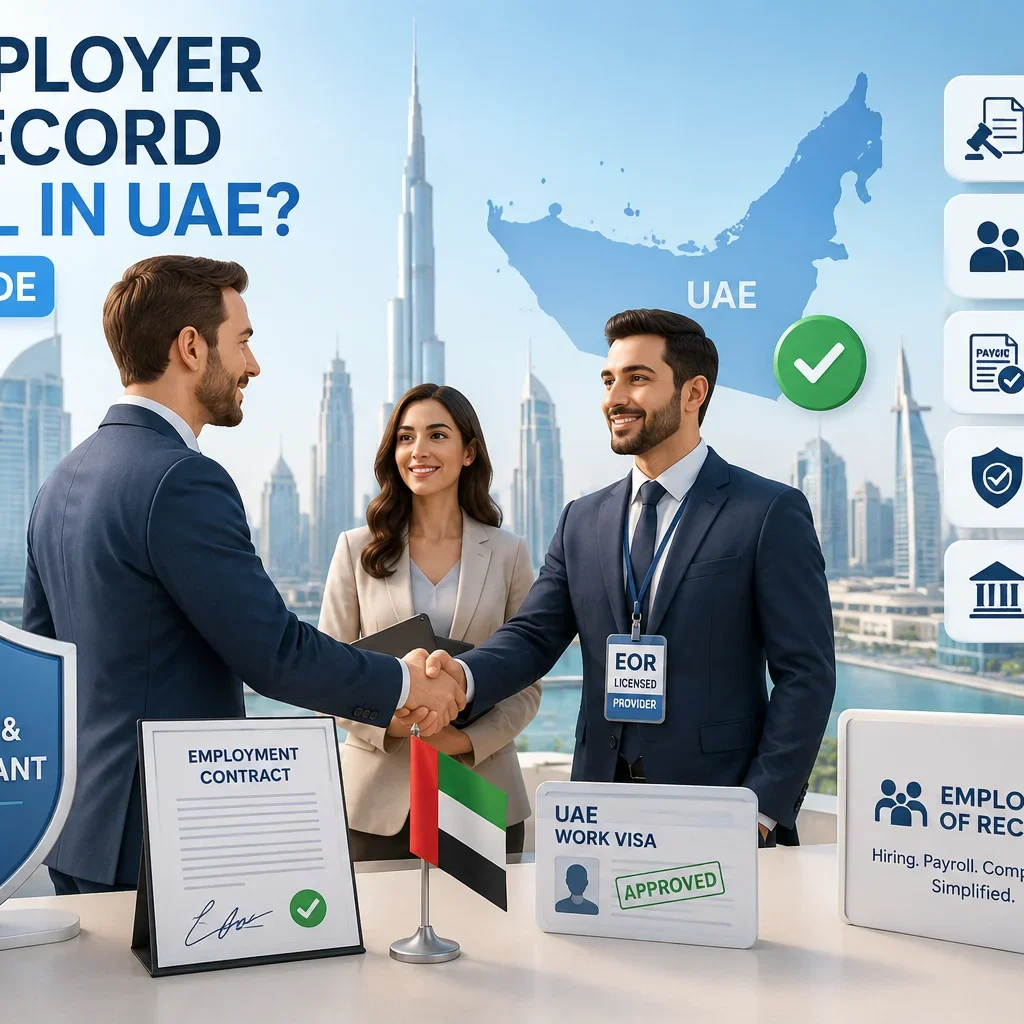
You can unlock valuable opportunities when expanding your business into the United Arab Emirates. However, your company may be exposed to legal risks if you don’t understand the country’s employment laws. Many foreign employers wonder whether using an Employer of Record is legal in the UAE or could create legal complications.
The uncertainty arises when hiring managers find conflicting information online and become confused about UAE labor regulations, visa sponsorship, and employer responsibilities. If you choose the wrong hiring approach, you may face three consequences: delays, penalties, or costly administrative challenges in the Gulf market.
The good news is that you can legally use an Employer of Record in the United Arab Emirates. This is only possible when certain conditions are met by the EOR provider. This guide explains those conditions, how an EOR works, its compliance requirements, and what you should know before hiring in the UAE.
Author
Co-author
Get in Touch with Us

Leah Maglalang
Business Coordinator UAE


Yes, an Employer of Record is legal in the United Arab Emirates when a licensed UAE entity provides the service. It must also comply with the country’s labor, immigration, and payroll laws. Although the UAE labor law doesn’t define the term “Employer of Record,” this employment model is recognized.
Many foreign employers ask this question because they have heard that having a local entity in the UAE is necessary, and they want to hire without one. In addition, even without a local entity, they want legal compliance in employment contracts, visa sponsorship, payroll, and employee benefits.
You should also understand the key difference between legal and regulated. A legal EOR operates within the UAE’s employment and immigration framework. On the other hand, a regulated EOR provider follows all licensing, labor, tax, payroll, and compliance requirements that the relevant authorities impose.

Federal Decree-Law No. 33 of 2021 forms the legal basis for Employer of Record services in the UAE. It governs private-sector employment and recognizes lawful relationships between employers and employees. This law has since been amended by Federal Decree-Law No. 20 of 2023, which revised the labor dispute resolution process. It gives MOHRE binding authority over claims under AED 50,000. However, this law doesn’t specifically define or reference the term “Employer of Record.” Federal Decree-Law No. 33 makes the legal employer responsible for employment contracts, wages, employee benefits, leave entitlements, end-of-service gratuity, and compliance with all labor obligations.
The Ministry of Human Resources and Emiratisation (MOHRE) also oversees private-sector employment. Licensed employers must register employees, issue compliant labor contracts, process salaries through the Wage Protection System (WPS), and comply with other UAE employment regulations.
Note that a dedicated ‘manpower/labor supply’ license, which requires 100% UAE national ownership and a bank guarantee of at least AED 1 million, is a separate, more restrictive license category than the standard trade license most EOR providers use; verify which license type your provider actually holds.

A legally compliant Employer of Record becomes the official employer in the UAE on your behalf when you partner with it. Then, your company manages the employee’s day-to-day work. The whole process follows these steps:
Client Company
↓
Signs a service agreement with the EOR
↓
EOR hires the employee under UAE labor law
↓
MOHRE-compliant employment contract is issued
↓
EOR sponsors the employee’s work visa and residency permit
↓
EOR manages payroll, benefits, and WPS compliance
↓
EOR handles ongoing HR, tax, and labor law compliance
↓
Client company directs the employee’s daily tasks and performance
By benefiting from this arrangement, foreign employers can hire employees in the UAE without establishing a legal entity. Simply stated, the EOR manages the legal aspects of employment, while the client company manages the employee’s daily workflow.
In an Employer of Record (EOR) arrangement, the EOR is the legal employer and is responsible for complying with UAE labor laws, while the client company oversees the employee’s day-to-day work and business objectives.
| Responsibility | Employer of Record | Client Company |
| Employment contract | ✔ | |
| Visa sponsorship | ✔ | |
| Payroll processing | ✔ | |
| Wage Protection System (WPS) | ✔ | |
| HR and labor law compliance | ✔ | |
| Employee benefits administration | ✔ | |
| Daily work assignments | ✔ | |
| KPIs and performance goals | ✔ | |
| Project management | ✔ | |
| Performance management | ✔ |
When you understand this separation of responsibilities, you can maintain legal compliance while retaining complete control over the employee’s daily tasks.

An EOR must comply with the same employment laws as any other employer in the UAE. This benefits employees by ensuring they receive all statutory rights while helping foreign companies minimize compliance risks. Key legal obligations that an EOR must follow are:

Yes, an EOR can legally operate in the UAE’s mainland and many free zones if it holds valid licenses and complies with the regulations of the relevant jurisdiction.
For mainland employment, an EOR must be a licensed UAE entity and comply with MOHRE regulations.
Many UAE free zones have their own employment authorities and licensing requirements. Therefore, an EOR must comply with the employment rules of the specific free zone in which it operates.
The Dubai International Financial Centre (DIFC) and Abu Dhabi Global Market (ADGM) operate under independent employment laws based on common law principles. An EOR must also be authorized to hire employees under these legal frameworks.
Before you choose an EOR, it is advisable to verify that it holds the appropriate licenses and legal authority to employ staff in the specific mainland, free zone, DIFC, or ADGM jurisdiction.

Remember that not every company that offers EOR services operates legally. An EOR becomes non-compliant when it cannot meet the UAE’s labor laws. If you partner with such an EOR, you may face legal penalties, visa issues, payroll disputes, and reputational risks. Common compliance violations that an EOR can commit are as follows:
Before you partner with an EOR, verify that it is legally authorized to employ workers in the UAE. A legitimate EOR should be transparent about its licenses, legal employment responsibilities, and compliance processes. You can use the following checklist to evaluate an EOR:
☐ Is the company licensed to operate and employ staff in the UAE?
☐ Does the EOR sponsor employment visas directly, rather than through an unrelated third party?
☐ Who signs the employment contract? The EOR should be the legal employer listed on the agreement.
☐ Who appears on the MOHRE employment records? The licensed EOR should be registered as the employer.
☐ Does the EOR process salaries through the Wage Protection System (WPS)?
☐ Can it legally issue work permits and residence visas for eligible employees?
☐ Is the EOR responsible for end-of-service gratuity, statutory benefits, and labor law compliance?
Note: If the answer to any of these questions is “no” or unclear, you should request additional documentation before signing an agreement.
A licensed Employer of Record benefits both foreign employers and the employees it hires for them. By assuming legal employment responsibilities, an EOR simplifies market entry while ensuring full compliance.
Businesses that want to expand their teams into the UAE have two hiring options: using an EOR or hiring directly by establishing their own legal entity. The right choice depends on your budget, hiring timeline, long-term goals, and compliance requirements.
| Factor | Employer of Record (EOR) | Opening a UAE Company |
| Setup Time | Hire employees within days or weeks | Entity setup may take several weeks or months |
| Cost | Lower upfront investment | Higher incorporation and ongoing operating costs |
| Compliance | Managed by the EOR | Fully managed by your company |
| Visa Sponsorship | Handled by the EOR | Your company sponsors employees directly |
| Payroll | Processed by the EOR, including WPS compliance | Managed internally or through a payroll provider |
| HR Administration | Managed by the EOR | Managed by your internal HR team |
| Market Entry | Fast and flexible for testing the UAE market | Best for long-term business operations |
| Flexibility | Easy to scale hiring up or down | Less flexible due to entity and regulatory commitments |
An EOR is the best option for employers seeking a fast, low-risk market entry without establishing a UAE entity.
Hiring in the UAE doesn’t require you to establish a registered company or navigate complex employment laws on your own. As a trusted EOR provider, FMC Group has been helping international companies hire talent in the UAE for over 8 years.
FMC Group manages every stage of the employment lifecycle, from compliant employment contracts and onboarding to payroll administration, WPS processing, employee benefits, visa sponsorship, and ongoing HR compliance.
Whether you want to test the UAE market, hire your first employee, or expand an existing workforce, FMC Group provides a flexible and compliant solution. Contact FMC Group to learn how our Employer of Record services can help you expand your business faster.
You are currently viewing a placeholder content from Calendly. To access the actual content, click the button below. Please note that doing so will share data with third-party providers.
More InformationYou are currently viewing a placeholder content from Calendly. To access the actual content, click the button below. Please note that doing so will share data with third-party providers.
More InformationYou need to load content from reCAPTCHA to submit the form. Please note that doing so will share data with third-party providers.
More InformationYou are currently viewing a placeholder content from Turnstile. To access the actual content, click the button below. Please note that doing so will share data with third-party providers.
More InformationYou are currently viewing a placeholder content from Vimeo. To access the actual content, click the button below. Please note that doing so will share data with third-party providers.
More InformationYou need to load content from reCAPTCHA to submit the form. Please note that doing so will share data with third-party providers.
More InformationYou are currently viewing a placeholder content from Elfsight. To access the actual content, click the button below. Please note that doing so will share data with third-party providers.
More InformationYou are currently viewing a placeholder content from reCAPTCHA. To access the actual content, click the button below. Please note that doing so will share data with third-party providers.
More Information