How to Sponsor a Türkiye Work Permit as a Foreign Employer

If you want to sponsor foreign employees in Türkiye and are looking for an expert guide, you are in the right place.

FMC Group has been providing employer of record services for 16 years, and managing work permits is part of its service. This means I have collected some valuable insights in this post.

This guide covers requirements, costs, a step-by-step process, and alternative solutions to get employees hired and working in Türkiye.

Let’s get started…

Picture of Özlem Çanakçı
Özlem Çanakçı

Author

Picture of Alp Atasoy
Alp Atasoy

Co-author

How to Sponsor a Turkiye Work Permit as a Foreign Employer

How to Sponsor a Türkiye Work Permit as a Foreign Employer

If you want to sponsor foreign employees in Türkiye and are looking for an expert guide, you are in the right place.

FMC Group has been providing employer of record services for 16 years, and managing work permits is part of its service. This means I have collected some valuable insights in this post.

This guide covers requirements, costs, a step-by-step process, and alternative solutions to get employees hired and working in Türkiye.

Let’s get started…

Picture of Özlem Çanakçı
Özlem Çanakçı

Author

Picture of Alp Atasoy
Alp Atasoy

Co-author

Table of Contents

Get in Touch with Us

Alp Atasoy

Alp Atasoy

Sales and Business Development Consultant

united states flag turkey flag france flag

Understanding Türkiye Work Permit

Understanding Turkiye Work Permit

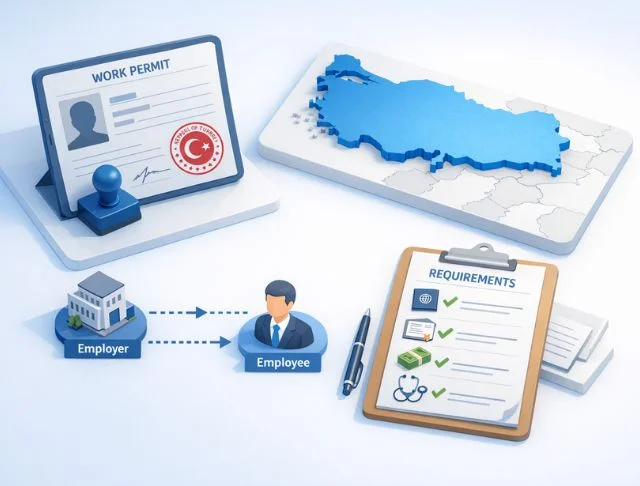
Before we come to the step-by-step process for sponsoring a Türkiye work permit, it is also important to understand all requirements from both sides, employers and employees, as well as the cost of this sponsorship. That is what we discuss in this section.

Requirements to Sponsor a Work Permit in Türkiye

To get a work permit in Türkiye as a foreign employer, you need to complete certain requirements, while other requirements must be met by employees. In some cases, you have to fulfill them from the employee’s side, such as a work visa. However, below is a clear breakdown of both parties’ legal requirements.

Employer Requirements

Below are the requirements that a foreign employer must fulfill before hiring an overseas employee:

You need to register a local entity in Türkiye.

You need to hire five local employees before hiring a foreign employee.

You should have minimum capital.

You must have complied with your company with tax and social security authorities.

You must clearly state that your business is legitimate and define the responsibilities of the hired employee.

Employee Requirements

Once you have completed all requirements as an employer, you still would not be able to get the work permit unless the foreign employee completes the following:

The employee must have a valid passport.

The employee must have relevant qualifications for the work for which they are being hired.

The employee must have signed an employment contract with the sponsoring company.

The employee must have agreed to the minimum salary threshold set by the Turkish government.

The employee must have a clean immigration record.

Cost of Sponsoring a Work Permit in Türkiye

When a foreign employer sponsors a work permit in Türkiye, the total cost depends on different factors. The total cost includes both direct government fees and ongoing employment costs:

Work permit fees: Government-issued permit and visa fees.

Legal and administrative costs: Document preparation, translation, and consultancy fees.

Salary requirements: Must meet minimum thresholds based on role and seniority.

Employer social security contributions: Approximately 37.5% of gross salary.

Additional compliance costs: Accounting, payroll, and ongoing regulatory obligations.

Note: I am not mentioning exact costs here because rules change continuously. Contact our experts for a free 30-minute call to get the exact cost of hiring in Türkiye.

Step-by-Step Process to Sponsor a Türkiye Work Permit

Step by Step Process to Sponsor a Turkiye Work Permit

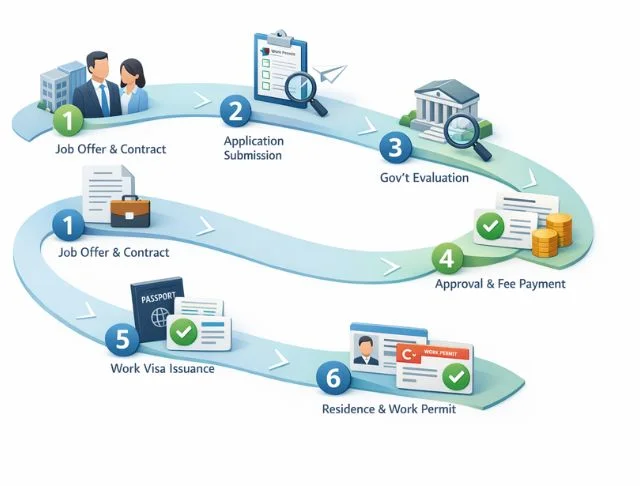
If you have completed all initial requirements set by the Turkish government, as discussed earlier, you can start the process of applying for a work permit. This is a straightforward process if done through the correct method.

Step 1# Ensure Employer Eligibility in Türkiye

Check your eligibility as an employer before moving to the next step. We discussed the requirements earlier. Are you meeting them? These include entities registered in Türkiye, the 5:1 rule, and compliance with tax and the Social Security Institution (SGK).

Step 2# Prepare a Compliant Employment Offer

If you are eligible to apply for a work permit for your employees, then start preparing the employment offer. In Türkiye, employers cannot randomly prepare contract drafts based on their own preferences. There are fixed rules set by the government. For example, you need to include working hours, pay for those hours, overtime rules, deliverables, termination rules, and more. Authorities also assess whether the role justifies hiring a foreign national.

Step 3# Initiate the Work Permit Application

The employer submits the application through the Ministry of Labor’s online system. There are two methods for applications:

From abroad: The employee applies at a Turkish consulate, and the employer submits the application in Türkiye.

From within Türkiye: Applicable if the employee already holds a valid residence permit with at least six months remaining.

Step 4# Submit Supporting Documents

What supporting documents are required for applying for a work permit in Türkiye?

Company registration documents, financial records, and employee credentials such as passports and diplomas are the documents that both the employee and employer need to submit. All documents must be accurate and properly formatted, and notarized translations are required. 

Step 5# Ministry Evaluation Process

The Ministry reviews the application, usually within 30 days. They ensure employer eligibility, salary compliance, and whether the role genuinely requires a foreign employee. Additional documents may be requested during this stage.

Step 6# Work Permit Approval and Visa Processing

If approved, the government grants a one-year work permit. After that, the employer must apply for an extension, and the permit may then be renewed for two years.

However, hiring still requires additional steps before onboarding the employee. Since the employee is a foreign national, they must obtain a work visa from the Turkish consulate before entering Türkiye. This step finalizes the legal right to work.

Step 7# Post-Approval Compliance Registration

After the employee starts work, the employer must register them with the social security system (SGK). Other ongoing obligations include payroll processing, tax payments, and maintaining full compliance with Turkish labor laws.

Alternative Options for Foreign Employers

Alternative Options for Foreign Employers

If you do not have a legal entity in Türkiye, sponsoring a work permit directly is not possible. In this case, foreign companies usually choose between an employer of record or contractors. Both options have their own pitfalls:

Option 1: Use an Employer of Record (EOR)

An Employer of Record (EOR) is a third-party provider that legally employs workers on your behalf in Türkiye. An EOR handles all legal, tax, and compliance responsibilities, while your role is to retain full control over the employee’s day-to-day work.

The core benefit of an EOR is that foreign employers can hire employees without setting up a local entity.

Key advantages

  • No need to establish a company in Türkiye
  • Fully compliant with local labor laws
  • Faster hiring process, often within 1 to 2 weeks
  • Handles payroll, taxes, social security, and recruitment

An EOR is the most suitable option for companies looking for speed, compliance, and low operational complexity.

Option 2: Hire Independent Contractors

Hiring independent contractors is the simplest and fastest way to engage talent in Türkiye. However, it also has its own drawbacks. These include misclassification risk, poor work performance or quality, and missed deadlines. These issues can waste time when testing different contractors, so companies often prefer employees for long-term goals.

Contractors work on a service basis and are not considered employees. This means there is no work permit sponsorship or employer obligations in the traditional sense.

Key advantages

  • No entity required
  • Minimal setup and administrative effort
  • Flexible, project-based engagement
  • Lower short-term costs

If a contractor is treated like a full-time employee, authorities may reclassify the relationship. This can lead to penalties and compliance issues. Contractors are best suited for short-term projects or non-core roles, not long-term employment.

The Smart Way to Hire in Türkiye: FMC Group

The Smart Way to Hire in Turkiye FMC Group

Expanding into Türkiye as a foreign company can be complex due to work permit rules, legal compliance, and payroll obligations.

FMC Group makes this process easier by offering seamless solutions, while you avoid the hassle of setting up a local entity.

By leveraging FMC Group’s Employer of Record (EOR) services, foreign companies can:

  • Hire fully compliant employees in Türkiye within days, not months
  • Avoid navigating Turkish labor law, tax, and social security requirements
  • Focus on managing the team’s daily operations while FMC Group handles payroll, benefits, and legal obligations
  • Reduce operational risk and administrative overhead

Whether you are looking to test the market, hire a small team, or scale quickly, FMC Group provides a complete set of services. You can hire employees legally, securely, quickly, and efficiently in Türkiye. This approach allows you to focus on growth rather than bureaucracy.

Get In Touch With Alp

We are looking forward to hearing from you